I’ll be putting on my September pants again. I’m going out shortly.
It’s an odd term, I guess, and not entirely accurate. I mean, my September pants are a whole lot like my August pants … and my May, June, and July pants. They’re possibly even the same pair of pants.
It’ll be different come October, though.
OK, I’ll go ahead and tell you. I call them my September pants (or June or July pants) because of how long I wear them. When the weather is warm, I don’t often wear pants. That’s fun to say, but it’s nothing scandalous. I just prefer to wear shorts while I’m at home or running errands. When I go to meetings or events, though, I feel obligated to put on pants. Because I wear the pants for only a couple of hours, I’ll hang them up and change back into shorts when I get home. They’re not dirty—and any creases smooth out on the hanger— so I’ll wear the same pair of pants the next time I go to a meeting. I can usually go a whole month with the same pair of pants. This month, they’re my September pants.
Like most people who abandoned the office during COVID and started working at home, I have a dual wardrobe for my nine-to-five. I always wear a collared shirt. (I mean, it’s usually a fishing shirt, so it’s definitely not dressy, but it’s always collared.) This way, when I have a meeting via Zoom, I look somewhat professional. From the waist down, though, I’m super casual in my shorts. You’ve seen maybe a million memes depicting this once-comical notion, but for me, it’s no joke. I’m going to wear shorts every day of the week.
The shorts/pants question is kind of a throwback to centuries past, when shorts were worn only by males of a certain age. After a boy reached puberty, he would set his shorts aside and don pants—and there was no going back. Maybe that’s why we still admonish people to “put on your big-boy pants” when it’s time to deal with a situation in a grown-up way.
I don’t think I have Peter Pan Syndrome, and I sure don’t mean to shirk adult responsibilities. I just really like wearing shorts when it’s warm outside. They’re cooler and less constricting. I realize I’m lucky to have that type of freedom in my work situation, and by golly, I’m taking advantage of it.
Summer’s over today, though. And while warm days will continue long into October, they’ll become less regular … and then vanish altogether. Autumn breezes turn into winter winds, thermometers peak at lower and lower points, and shorts become impractical.
It’s not that big of a deal to wear pants, of course, yet I’ll miss my shorts and the summer-break feeling they inspire. Once the warmth is gone, I’ll pull on my big-boy pants—some of them lined with fleece. But hey, spring is always around the corner. And as the days heat up, I’ll be back in shorts. I’ll return to wearing long pants only as many hours as needed, and then they’ll go back on the hanger. Before you know it, I’ll be talking about my April pants.
The first time I went to the Hancock home, my new friend Don pointed a rifle at me and started firing.
Don in sixth grade, from the Midway Elementary School yearbook
Technically, he was shooting at his twin brother, Ben—and I think it was just BBs—but I was standing with Ben, so I had to take cover, too. I had only recently become friends with the twins, even though we were all from the same little town. The Hancocks were in one sixth-grade class at Midway Elementary School, and I was in the other. And until that year, I went to the Presbyterian church, and they went to Midway Christian. That’s how people in tiny towns settle into groups.
But in 1969, I started attending CYF youth group meetings at the Christian Church, led by a young minister, Bill McDonald. They were doing fun stuff, while everything at my family’s Presbyterian church was a bit sleepy. And let me tell you: A lot of the fun stuff centered on the Hancock twins.
In one way, they were like the Hungarian pillbugs in “A Bug’s Life.” Where the cartoon twins were tumblers, though, the real-life twins were talkers. Ben was a charmer, and Don could rationalize anything. But what the Hancocks had in common with Tuck and Roll, the pillbugs, was that they would start fighting at the drop of a hat: fisticuffs, wrestling, or even riflery.
I don’t know what set Don off when I went home with them after school that day in ’69. I think he was mad because I had sort of paired off with Ben, and in his third-wheel anger he grabbed a BB gun and started shooting. Ben and I hopped behind a wall at the bottom of the driveway. There were no cars there because neither parent was home, which made the Hancock house that much more fun.
Throughout the next decade, I spent a lot of time out at the Hancock place. Even when the parents were home, we did things I couldn’t dream of getting away with at my house. The twins had a big brother, Tilton, who hated his brothers but tolerated their friends: Billy Haynes, Jonathan Clifton, sometimes Mac McCauley, and me.
Don was a lot like the skyrockets we often launched. The boy had a short fuse on his brain’s amygdala, which led to trouble in the classroom and fights outside. Something caused that anger, but I’ll never know exactly what went on in that house of his when his friends weren’t there. When I was young, I didn’t know to ask. When I became older, I didn’t want to know.
Don, entertaining classmate Monkey McClain at Midway Elementary.
I do know that Don demanded to be noticed. When you were in the room with Don, you could count on weathering a nonstop series of pranks, pratfalls, and preposterous statements, all aimed at getting your attention. He was a relentless pest, and you seldom heard his name said aloud without “damn” in front of it and “stop” after it.
Damn, Don—stop!
While it was often hard to like Don, it was impossible to hate him. The boy was soft-hearted, inquisitive, generous, and kind. He would perform any favor you asked. And he was loyal.
“I never had to wonder if Don was going to be present for Sunday CYF meetings or other activities. Of course he would be there,” says Bill McDonald. “He was the consummate CYF member—dedicated to the group, dependable, faithful … and energetic about the concept.”
Midway Christian Church youth group, circa 1970
Don’s church involvement didn’t stop when we graduated from the youth group. We both joined the church choir. What Don lacked in musical talent, he made up for in consistency. Don never missed choir practice, and we would usually go together. He’d pick me up, we’d attend practice, and then we’d ride around and drink beer.
Riding with Don was a new act of a familiar play. Our group had long been dedicated to cruising, piling into a car with Tilton before we could drive and in one vehicle or another after Tilton departed for college. During those six or so years, we’d drive over to Versailles most nights. Midway had no stores open past five and, more important, no possibility of romance. The limited number of Midway girls our age had long since lost interest in us, so we did our cruising in Versailles. Honestly, the girls there weren’t any more interested in us, but at least there were fast food restaurants and convenience stores in the larger town.
Ben (left) and Don, 1974 yearbook, Woodford County High School
The twins were given a Chevy Vega on their sixteenth birthday, and that was our cruising car for a while. And then at some point, maybe when we were seventeen or so, Don started collecting automobiles.
I don’t mean to say he ever had a collection; it was just one car at a time. He first cajoled some money from his grandfather and purchased a used car, which he wrecked in short order. From there, he went through cars like most people go through a tube of toothpaste, getting a new one every few months.
Some cars he wrecked, some he sold, and some he swapped. He’d use insurance money, earned money, or borrowed money. Billy Haynes remembers that one car was torn apart by a pair of Frankfort policemen only a few hours after Don had acquired it. Whatever they were looking for, they failed to find. I checked with Billy and other friends and family members, and none of us can say just how many cars Don used and abused. I would guess he went through two dozen by the time he turned twenty.
The ugly Bug, parked at the McDonalds’ house. In the car (l to r) are me, Ben Hancock, and Don. Justin McDonald is pedaling the Big Wheel.
I remember only two of Don’s automobiles well, and they were at opposite extremes of the eye test. The ugliest car Don ever drove was a Volkswagen Beetle. It was already souped up (ruined, really) when he bought it. It had three sets of headlights and an orange, red, and brown paint job that established the VW Bug as the most hideous vehicle on the road. Dirty shag carpet covered nearly all of the interior, but a sunroof helped offset what was otherwise a smelly experience. I’m not sure how long Don had that car or what happened to it, but I’m sure it wasn’t stolen. People laughed out loud when he drove by.
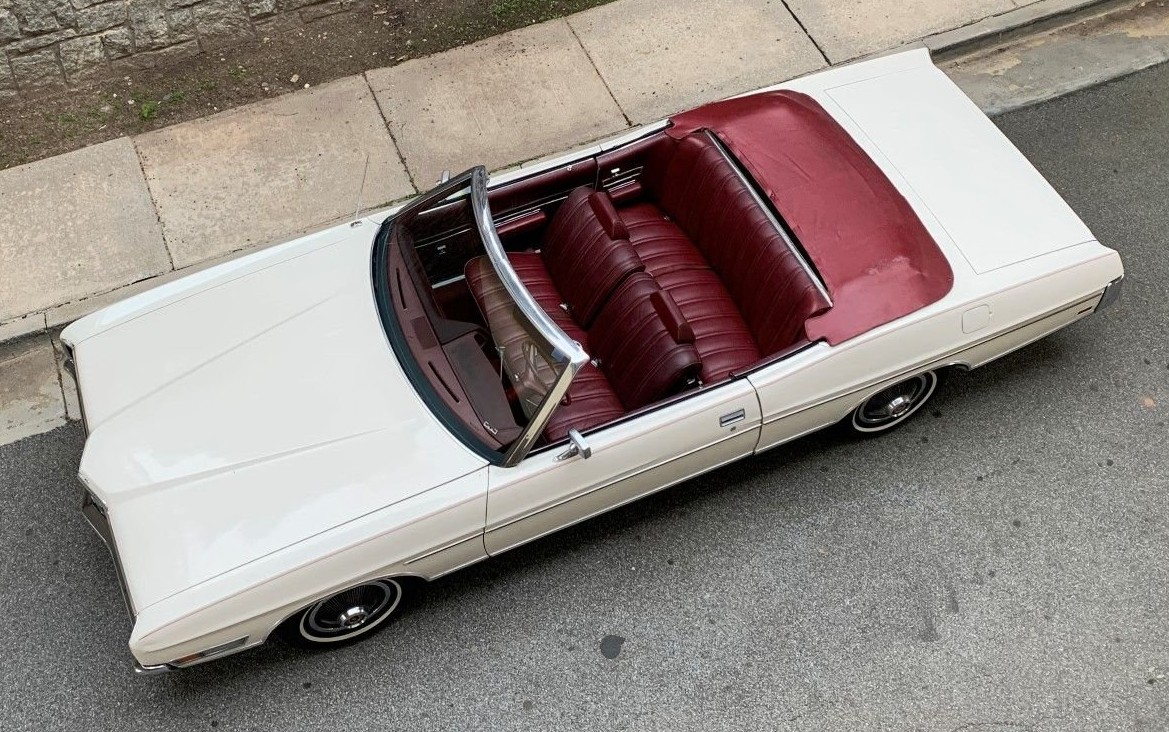
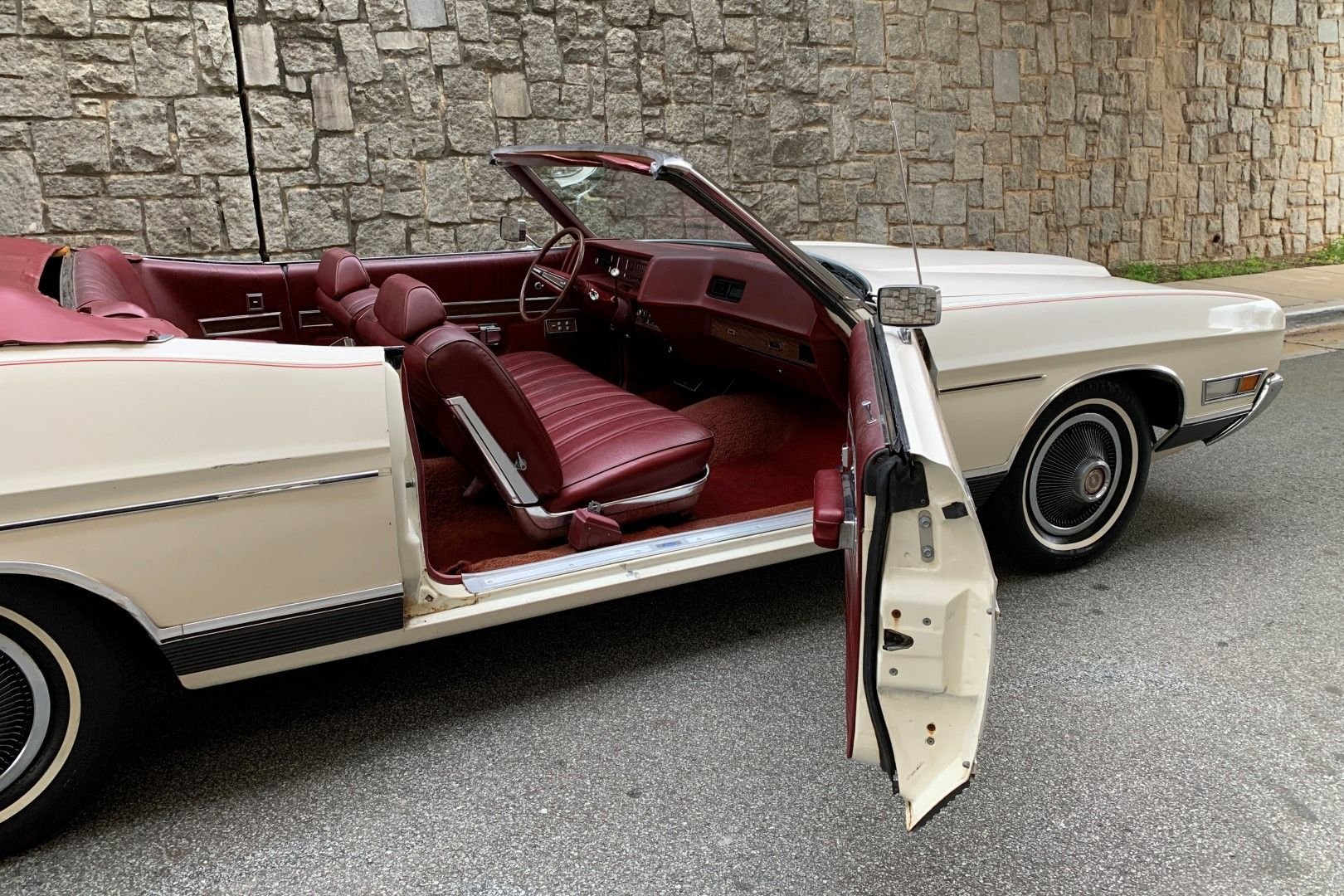
If the Bug was the beast of Don’s automotive acquisitions, the beauty was the car I remember best: a 1972 Ford LTD convertible, white, with burgundy leather interior. I’m guessing at the year of the car and when he had it, but I think it was the summer of ’77. I was sort of between friends at that time. Our once tight group had mostly drifted apart after high school. I was home from my one year of attending college out of state (Auburn), and I had not yet started at nearby Transylvania, where, beginning that fall, I would compile a new set of friends.
A 1972 Ford LTD convertible, shown here listed for sale online. It’s similar to Don’s, except it’s intact. I’m confident Don wrecked his.
That summer, though, I rode with Don.
Being out of high school, I felt a little like John Milner in American Graffiti, the guy who should have moved on from cruising when his high school days were over. I don’t remember very much from the many nights we cruised Versailles during those months. We had a route we’d drive, stopping to talk with any girls who weren’t fast enough to run inside when they saw us coming.
I do remember that on some nights as we were leaving Versailles to drive back to Midway, we’d stop to put the top up, raising the lid on the convertible and closing the book on another night of aimless driving. Don would soon be driving a hundred miles an hour on Midway Road, so raising the roof seemed sensible.
Other nights, though, we’d keep the top down. I still remember those rides home, hurtling along the narrow road past dark pastures and corn fields, the wind buffeting my face and chilling my body, even in the middle of summer. I couldn’t hear the car engine, of course, and I couldn’t see anything outside of the headlight beams. It felt like we were flying.
That summer was the most time I’d ever spent alone with Don. I sometimes did things with the other Hancock brothers and our friends, but nobody else rode around with Don and me. Don could be erratic, as I’ve explained, but he was normal enough on our nights together. I suppose Don was doing drugs, but he didn’t do them around me. We did drink a beer or two. Or three.
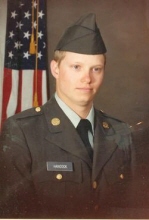
Don, in the U.S. Army for a short time, was stationed in Alaska.
We also talked a good bit. Like all of us—especially at that age—Don was searching for a place in the world. He always had big dreams that were interrupted by reality … and grand plans that never got off the ground. In the years ahead, Don had a checkered work career that included a short stint in the Army. Eventually, he ended up where he started, on the family farm.
I lost touch with Don after I finished college and grad school and remained in Lexington, where I married and started a family. I never stopped being a Midway boy with hometown connections, though, and I heard a lot about Don through the years. None of it was good, as his demons and addictions took control, smothering much of the goodness in his heart.
But not all of it.
Don died in 2009, soon after he turned fifty. On the funeral home website, there were three comments on Don’s page, and one of them described his generous spirit. A fellow I don’t know wrote that whenever Don would come into some money, he would go to a little grocery near the farm and “buy beer and food for everyone in the store.”
The last time I saw Don was after I returned home to Woodford County. It was 2004(ish), and I was outside with my son Steele, who, at seven or eight years old, was riding his bike on our driveway. A small man on a big motorcycle came roaring up the driveway, and I walked out to intercept him. It was Don. I hadn’t seen him for several years. He was older, as was I, of course, but the years had weighed harder on Don.
We talked about our respective jobs and wives. Don said he didn’t have any kids, and I told him about my two sons. I did not call Steele over to meet Don. I did not invite Don into my house. I did not ask for his phone number, because I did not intend to connect with him again. And maybe Don was fine with that. Perhaps he was simply riding past my house and stopped by when he saw me outside.
But maybe he wasn’t fine with it. It’s possible that Don wanted to relive the memories of our time in youth group, talk about the friends we made at church camp, and revive the good talks we shared on the road in his white convertible.
I didn’t, though. I just … couldn’t. I feared that Don’s troubled life would bring trouble to my family, and I let him ride away with no plans for us to get together. We never talked again. He had been the most loyal friend of my youth, and I failed to return that loyalty.
It makes me sad.
I can’t stay sad when I think of Don, though, just as I couldn’t stay mad when he said or did the most irritating things imaginable. Even that first time I went to the Hancock home, we all started playing together after he, you know, stopped shooting. And I can’t be sad about the many miles our group covered together on Woodford County roads.
In my fifty years of driving, I haven’t owned as many vehicles as Don did in one year during his late teens. All the cars and pickups I’ve owned were practical and reliable. But there will always be that one flashy car—and that one fast summer—I shared with Don. And in my mind, the top will always be down … and we’ll always be flying.


 Of a Midway Mind