Looking at liriope

I’m looking at the liriope [lih-RYE-oh-pee] we planted a couple of years ago, and I don’t know what will happen.

Also called monkey grass, these clumps of leafy plants make good border vegetation, and the plants are pretty hardy.

For two winters, I have cut back the leaves that died in the cold, and I did it with the loving care of a weed eater—just whacked all the clumps down to the nub. And then in spring, little green leaves just shoot up and grow.

The liriope was greening up nicely this spring, but then we had a couple of hard freezes,LiriopeBig when temps dove into the low 20s. There’s warmth and sunlight now, but those cold nights took a toll on the liriope. Big sections of rich and verdant growth are now quite pale, even white.

So now what, I wonder. Will the pale leaves linger? Die off, even? And will new, green ones grow in their place? Or maybe the entire plant will spiral down to die. Some plants are doing better than others, so maybe some will recover and others won’t.

You probably guessed where this is going. There are other worries on my mind.

In the same way I’m looking at my liriope, I’m wondering about my country, my state, my neighbors, and my family. Will the virus that put our economy in the deep freeze ruin our way of life forever? Or can we recover and resume where we left off? Or maybe new jobs and opportunities will replace the ones that didn’t survive the COVID crisis. And, worse, will the dreaded virus strike a loved one?

I flat-out don’t know.

To learn the liriope’s fate, I could ask a botanist or a horticulturist—or probably even the lady at the lawn and garden shop. They would know, as they’ve seen that situation before.

But diagnosing a nation’s recovery from the coronavirus crisis is not as simple. While there’s no shortage of experts in economics, virology, and public health, there are no sure-fire answers. Unlike a mid-April freeze that cripples plants, a pandemic like this one has never before been faced in the modern world. Those experts can build models and make predictions, but their projections are just educated guesses. And many educated experts have already guessed wrong.

It’s also easier to look at liriope because I don’t have to suffer a stream of uneducated guesses—other than my own—like we’re all enduring through this COVID lockdown. The fear and distrust and hatred that spawn all sorts of corona-crap don’t really play into plant life.

Of course, while doctors and economists can’t forecast with certainty what will happen in six months, they can deliver solid expectations of what can happen in six days to people who don’t heed warnings about catching or spreading the coronavirus. (Hint: They’ll catch it or spread it.) But it’s the sixth months and more that worry me.

Time, I guess, will tell … both for my clumps of monkey grass and for the global economy. There’s a lot more riding on the outcome of the latter, but pondering all the upshots and outcomes of the coronavirus disaster—week after week—can weigh a man down.

I don’t want to close my eyes to further threats, but I can’t think about the whole world just now.

Today I’m going to look a little longer at my liriope. Maybe I’ll see some signs of life.

LiriopeSmall

Let it be

What’s your quarantine theme song? As all Facebook and Twitter devotees know, it’s the title of the single that was the No. 1 song on your twelfth birthday.

I am no stranger to social media silliness. I rarely pass up the chance to complete a Facebook survey—but only if it sets up my signature smartassery. And I always respond to copied-and-pasted posts that beseech friends to answer—with one word—“how we first met.” I invariably reply “prison.”

The process of determining your quarantine theme song, though, isn’t the type of Facebook game I usually play. That’s because it offers no room for creativity; you simply report the fact. I do like music, though, especially—and I make no apologies—Top 40 tunes, so I Googled April 16, 1970.

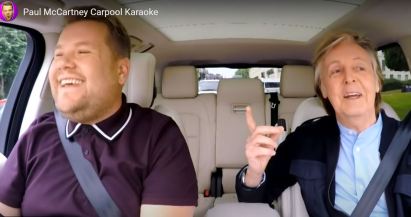
I was lucky. “Let It Be,” the beautiful Beatles song, checks all the boxes for this exercise. The phrase sets an appropriate attitude for these weird and daunting days. And the song has enduring appeal and popularity. Two years ago, Paul McCartney explained the originCarpool of the song to James Corden during an emotional episode of Carpool Karaoke. The former Beatle had written the song following a dream in which his deceased mother came to him and said everything was going to be OK. “Just let it be.”

Plus, like the millions of music-lovers who made it No. 1, I really like the song.

But to truly earn the role of my personal quarantine theme song, the tune has to do more. So on a day leading up to my sixty-second birthday (a frickin’ half-century after I turned 12), I looked to the lyrics to see how “Let It Be” measures up as a leitmotif for a time when we huddle at home to diminish the spread of Covid-19.

“For though they may be parted …”   This viral scourge has wrecked our world. People have had to say goodbye to loved ones, to their jobs, to the milestones of life, and so much more. And to make it worse, parting words can only be said through windows or on Zoom and other electronic connecting points. Some of what we’ve collectively lost can be regained, but so many lives and events are gone forever.

“Speaking words of wisdom …”   If we have learned nothing else during the pandemic, we should all take home the lesson that scientists offer solutions. Some politicians—and Kentucky Governor Andy Beshear is a shining example—have heeded the words of epidemiologists and public health professionals and insisted that their constituents take safe and sane precautions, But other officials have delayed such measures or have taken political posturing to absurd lows.

“I wake up to the sound of music …”   I’m forever seeking solace and inspiration in music: I constantly listen to songs from the decades of my life; ideas and phrases frequently come to my mind in rhythm and rhyme; and I often do a deep dive on particular songs, artists, or musical experiences. Just this week, I have zeroed in on the early music of Chicago (watching a concert video) and on the rock opera Jesus Christ Superstar (viewing a modern-day version of the musical on YouTube). Notably, both the concert video and the original Superstar were created in 1970.

“And when the night is cloudy, there is still a light that shines on me.”   I’m afraid of catching Covid-19; my asthmatic lungs might not fare well against the virus. I fear the loss of my job and for the livelihoods of millions of Americans and scores of neighbors, as I also grieve for those who have already lost their jobs. I’m angry that our leaders won’t learn from this catastrophe and create a more affordable health care system—or that foolish citizens will again be fooled by con artists in power. There is much about this crisis that makes me think we won’t emerge from our dark days with any semblance of a functioning, decent society. And yet I believe we will. I’m not a religious man, but I believe in the light.

“Let it be.”   Perhaps the only phrase of this song that doesn’t ring totally true with me is the title itself. Paul McCartney interpreted his mother’s words in that dream to mean “don’t worry about it.” And it’s true that much of the damage done by the novel coronavirus is out of our control. But what happens next—in our lives, our communities, and in our nation—is up to us. We can show compassion, we can offer help, and we can vote. Believe what you will about a scripted future, but do what you can to make it better.

I want to listen to words of wisdom. I want to believe there will come an answer. And I want that light to shine on until tomorrow.

So yes … Let It Be.

The View from Pew Three

Oh, holy night indeed.

The Christmas Eve midnight service at Midway Community Church was the best possible night for a date. Lighted with candles set on the sill of each stained-glass window, the sanctuary was full of people, yet remarkably silent.

And those candles didn’t merely glow, for the towering windows didn’t seal completely, and each wisp of cold December air that snuck inside invited the flames of the candles to dance. And they accepted. The light, then, was alive. And its flickers made the night even more magical.

For thirty delicious minutes, a guy could sit with his girl in close quarters on a wooden pew smoothed by generations of worshippers. Decades of derrieres. Thighs comfortably conjoined. Hands perfectly positioned to be inched … over … and clasped.

This service on the holiest of Christian nights was not meant to be romantic, but Lord, a guy might pray every day not for salvation, but for these thirty … delicious … minutes. With her.

But he wasn’t with her. Glenn was seated in close quarters, but not with the prettiest girl in high school—the girl of his dreams … the girls of his prayers—but with the guys he’d grown up with.

The two pews down front were the domain of the church’s youth group. Required to attend Sunday services in order to take part in bowling or a movie or whatever the group did Sunday evenings, the teen-agers showed up, and they sat with each other in the second and third pews.

Throughout the year, the front pew was left empty for two reasons. One, it was where the deacons sat temporarily when they gathered at the altar to divvy up the offering plates. But also, anybody sitting on the front pew would be completely exposed, so that choir members—and Preacher Ted—would be able to see any note-passing or knee-poking.

But on Christmas Eve, even the very front pews were filled. Family members from out of town blended with backsliders, who came to church just once a year, to increase attendance tenfold. And for the most part, the out-of-town crowd was not given to knee-poking.

Yet for Glenn, surrounded by hundreds of worshippers, it was a crowd of two: himself and her. She was in the second pew, and he was in the third. And it was driving him mad.

It’s the curl of her hair, he decided.

Seated directly behind her, Glenn had a fantastic view of her hair. Brown and lush—lush hairclipwas a good word for it, he thought—it cascaded in front of him …  almost for him. She had pulled wide strands from near her face and gathered them in the back with a silver clip.

He tried to remember the word for the clip. He didn’t think it was a barrette, but a clip had more of a squeezy action, and he couldn’t tell if the silver thing was squeezed to open and gather up her hair. It wasn’t a pin; he was sure. Maybe it was a clip.

But the effect was marvelous. The two strands that Kasey pulled away from her face were a little bit lighter brown than the hair it joined in the back—the hair that cascaded in front of him. And those strands, as well as the rest of her lush brown hair, had soft, perfect curls.

Her hair completely hid the back of her neck, it was so thick. And it was long enough that it flowed past her shoulder blades and over the back of the pew in which she sat. Technically, Glenn decided, her hair was in his row, in his pew. He wasn’t sitting with her, but kind of, he was sitting with her hair.

Glenn had hoped for a different seating arrangement, especially tonight. For most of the fall, when both of them began their junior year at Midway High, Glenn had worked the angles.

  • He followed her into Algebra II on the first day so he could sit in the desk beside hers.
  • He always timed his departure from Chemistry third hour so their arrival at the lunch room might coincide. (He knew he wouldn’t sit at her table—that was for cheerleaders and boyfriends only—but he might be able to fall into the lunch line behind her.)
  • He never missed a Sunday night youth group meeting, knowing she’d probably be there and hoping he could possibly sit near her—even next to her—in the van, at the movie, or at the pizza place.

He played all the angles and, for the most part, was successful. He spent quality time near her. And several times that fall, they had talked. Sometimes just a greeting, but often—well, at least five times—they had exchanged full sentences: opinions about a TV show or agreements about homework being hard.

One time in early November, Glenn almost mustered the courage to ask her out, like, on a real date to a restaurant in Lexington … or to a movie—just the two of them.

But it wasn’t just the two of them. Kasey was with Abner, and he was with the gods. Ab was muscular and handsome, athletic and artistic, intelligent and authentic. Ab was friendly, popular, and talented. He was adored as much by teachers as he was by his classmates—even the stoners loved Ab. He was perfect.

And Glenn was not.

At least he could sing, though. And when the congregation stood and joined their voices—without the organ—to sing “Angels We Have Heard on High,” Glenn unleashed his brilliant bass, sweetly singing (as it were) o’er the plain voices of his buddies beside him. And when he belted the bass line of the chorus—the extended “Gloria” prior to “in excelsis Deo”—it flowed like a counter melody … a solo performance of sorts.

And she turned and smiled. And raised her eyebrows a bit. At him.

The look and the lift lasted only a second. Literally, one second. But it was glorious. It was frickin’ in excelsis.

And it was Christmas Eve and it was his church and his night. And it was his girlfriend … or … his friend who was a girl.

It was completely Christmas Eve.

Oh, holy night. Indeed.

Traffic Jams Are for Creeps

Traffic jams. You could say the phrase is positive, because when you’re stuck in traffic you have extra time to listen to your favorite jams.

TrafficBlogCarsBut don’t say that. Sitting in traffic jams is a losing proposition. You lose time at work. You lose family time. And sometimes, well, you lose your shit.

I can’t eliminate road rage and traffic jams, but I can put a dent in reduce the time we spend in snaky, snarly lines of traffic. Disclaimer: I need every driver in America to read and obey this essay.

That’s a lot to disclaim, I know. But I do have an answer, which, like most solutions to life’s problems, I learned in my years as a baseball dad. Cap-tip here to my friend David Couch, perhaps the most complete baseball coach either of my sons ever had. (David coached my second son, Clay, when he was 9. Clay, not David.)

Coach Couch told his Reds that when they’re in the field, playing defense, they should move forward with each pitch. Just a little. Not a lunge or a lurch, but a subtle move. Take small, almost unnoticeable steps. Creep toward the batter.

By making tiny shifts toward the plate, Coach Couch would say, you are ever-so-slightly building forward momentum, and if the ball is put in play, you’ll already be in motion. Your first step to the ball will be quicker because you started it before the ball was struck. If you have to stop or go the opposite way, you can, because you weren’t lurching or lunging. You were only creeping: employing subtle movement toward your target.

And your target as a driver, ladies and gentlemen, is the other side of the intersection before the damn light turns red.

In a perfect world of traffic, all of us would react immediately to the green light and go—fast. With each driver accelerating quickly as the light turned, the entire column of cars would, as a group, rocket forward to the desired cruising speed. Traffic lights would be perfectly timed so we would all achieve rapid (but safe) advancement.

But our traffic world is far from perfect. And one significant problem is that the drivers in front of you react slowly to the green light. They might have been texting or dozing or zoned out, and they don’t notice that it’s time to go until a few car lengths open up in front of them. And you know what would fit nicely into those empty car lengths? More cars! These drivers are dawdlers, and every dawdler that gets a late jump creates more unused space that delays the drivers behind them.

Also slowing you down are fainthearts. Overly cautious drivers, fainthearts intentionally allow space to build between themselves and the car in front. They remember well the drivers’ manual that prescribed ample stopping distance as a defense against certain death on the highway. Of course, you’re not on the highway with its high speeds. You’re in city traffic. Doing 4 mph.

According to my complex traffic models and scientific calculations, these unnecessary gaps between vehicles decrease traffic flow by 28 percent. Admittedly, my traffic models and calculations were created in my head while I was sitting in traffic.

It’s fair to say, though, that by eliminating the needless spaces that drivers create—either through inattention or fear—more cars could get through an intersection. Maybe yours, too. It’s that 28 percent inefficiency I seek to correct, which would make drivers more likely to get to work on time and get home sooner to their families (and Netflix), and less likely to become road ragers.

One common action is no help at all. Often I’ll see dawdlers snap to it and give it the gas, quickly eating up the 30 or so yards of slack they created with their negligence. But for the rest of us to catch up, we must similarly rocket forward, and as we discussed earlier in our perfect-world scenario, that ain’t happenin’.

So you must creep. Just like a second baseman on Coach Couch’s Reds, you’ve got to creep forward as the pitch is thrown—or, in this case, as the light loses its redness. If everyone is creeping, you’re all on the move sooner. You’re not rocketing, but you’re advancing. And as you advance to, say, 5 or 6 mph, then you can allow a little space between you and the guy in front of you. It’s more efficient to cede space on the move than from a dead stop.

It’s all part of my 28 percent plan for improvement. When everybody creeps in traffic, more of us can get through the light. We’ll get to work or home sooner. And your jams? Just play “Life Is a Highway,” “Shut Up and Drive” and maybe “Hot Rod Lincoln.”

Burial at Sea(t)

“My plate’s pretty full right now.”

You probably hear or say a variation of that phrase every day, and I say it myself sometimes. We’re not at the China Buffet when we say it, of course. We’re likely talking to someone who has just asked us to take on a project for work or church or community or school or whatever. It’s not that we don’t want to do it; it’s just that our plate is already full of projects for work and church and community and school and whatever.

And while I might say that my plate is full, that’s not the truth. What I mean is my seat is full. My chair at the table in our breakfast room is the repository for all the stuff I need to deal with: bills to be paid, mail to be handled, receipts to be filed, magazines to be read, and items to be stored.

This system was created by my wife, who has a knack—and a need—for neatness. At some point Mary Beth must have dropped off my daily mail on the table in front of my seat, probably after finding the mail-sorter-thingy already filled with bills to be paid, mail to be … you get the picture. After a few days of mail piled up, she must have asked me to go through my stuff, and I possibly/probably moved it from the table to the seat. Out of sight, don’t you know. After a while, Mary Beth just started adding to the stack of stuff on the chair.

So my system has come to this: Periodically I’ll stand by the chair and sort through the stack-o-crap and see if there is anything that requires urgent action. Naturally, the non-urgent stuff just stays on the stack. You might be asking—as my wife does with increasing intensity—why I don’t just handle these items as they come in. Just pay the bill, read the article, file the receipt, etc.

That’s like asking the manager of a restaurant why you have to wait for your food: If they’d simply cook it right after you ordered it, you’d be fed and gone much sooner. But like the kitchen at a popular restaurant, I get a little backed up.

You should see me sit in the damned thing. On any given day the seat could be loaded with three newspapers, a legal pad with notes from Wednesday’s meeting, a pack of light bulbs I need to return to Kroger (wrong size), and forty-three pieces of mail, so I have to perch my butt on about an inch and a half of wood. One day soon, the chair will flip forward and dump all that stuff on top of me. I’ll be buried beneath my backlog.

If you’d like to discuss this situation in person, feel free to stop by the house and come on in. Oh, don’t sit there, though.

Why the Blog, Bob?

You’re asking why, of course. Why is Bob blogging? Aren’t those snarky comments on Facebook providing enough of a creative outlet? (And can we talk him into confining his thoughts to Twitter, where he can’t elaborate?)

Nope. It’s a blog for me. I’ve had multiple requests from Facebook friends to start a blog. And yes, three counts as “multiple.” And no, they didn’t say that just to get me off Facebook. I mean, surely not.

I’ve been meaning to blog anyway. Seriously. I do some of my best writing in spates of 400 words. I call them essays because I like the sound of it. I might even start referring to myself as an essayist – possibly on my business cards. Not that I generate much business as a writer, but still. My dad told me he never really believed I was a writer until he saw my business cards that read “Bob Rouse, writer.” So maybe I can convince people I’m an essayist, too.

Bob Rouse, essayist.

It tickles me to death that the definition of essay on Wikipedia is “… vague, overlapping with those of an article, a pamphlet and a short story.” For my purposes here, “vague” offers a certain protection, allowing me to operate outside of the rules and conventions of other writing forms. (I do not intend to stray into the realm of “pamphlet,” though, as I had assumed that term was long dead and buried.)

What I suspect this blog will be – though in entry No. 1 I cannot be certain – is a series of essays (non-pamphlets) that reflect my internal thoughts … except with a filter, however diaphanous. I will, at various times, attempt humor, opinion or poignancy.

And if I could, I would charge extra for six-dollar words such as “diaphanous.” Sadly, all this comes free of charge to you. And profit to me. Like most of my writing.

Let me conclude with a few words about writing: It’s how I express myself. (Duh, right?) I enjoy the process of choosing words to express specific thoughts and feelings.

I’d rather sing, of course. And I’m not a bad singer, but I’m not good enough to make a living at it. So am I making a living as a writer? Going to work and choosing just the right … whaddya call it, um … words?

Yes I am. Kinda sorta.